AI: Bill Gates Warns It Makes Nuclear Weapons Look Like Nothing
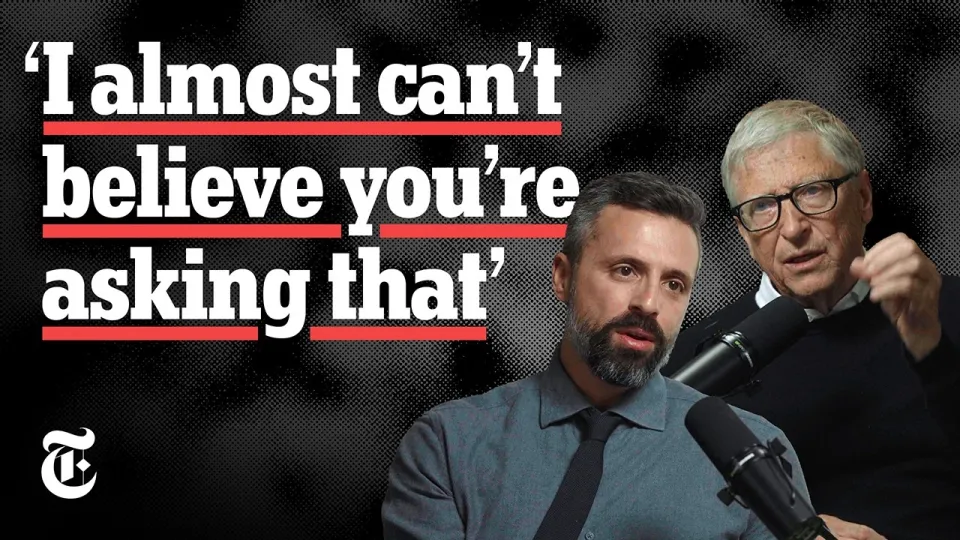
Video: Bill Gates: A.I. ‘Makes Nuclear Weapons Look Like Nothing’ | The Ezra Klein Show
Need articles like this for your video? They help promote it on YouTube and Google — order them in the Telegram bot @sat_sit_bot. Articles with your video embedded are written and posted by the bot itself — on popular topical sites (no ads). Your first 50 articles are free.
· based on the channel The Ezra Klein Show
Key takeaways
- Gates calls AI the most dangerous technology humanity has approached, saying it makes nuclear weapons 'look like nothing.'
- He calls industry self-regulation of AI 'insane' and wants government-set thresholds for cyber and bio capabilities.
- His predicted harms: catastrophic cyberattacks, bioterrorism and mass job loss, arriving faster than policy.
- The Gates Foundation plans to spend roughly $200 billion over two decades, with AI-driven inequality a new priority.
- He frames the US–China AI race as a reason for safety rules, not an excuse to skip them.
Bill Gates argues that AI is the most dangerous technology humanity has ever approached — dangerous enough, in his words, to make nuclear weapons "look like nothing" — and that governments, not the industry, must set the rules before catastrophic cyberattacks, bioterrorism or mass job loss arrive. He makes the case in a long conversation with Ezra Klein, published by The New York Times Opinion; the full transcript and episode are available at the podcast page for the Bill Gates interview. Gates' core claim is not that AI should be slowed to a halt, but that the gap between what labs are building and what regulators understand is the actual emergency.
What Gates actually said about AI risk
Gates' position is a reversal of his earlier optimism about artificial intelligence, and the shift is the spine of the episode. For years he was among the most prominent technologists arguing that AI would mostly be a force multiplier for medicine, education and productivity. In this conversation he keeps that optimism about the upside — vaccines, tutoring, agricultural yields — but places a much darker forecast next to it: the same capability that designs a drug can design a pathogen, and the same model that hardens a network can break one.
The specific harms he names are concrete rather than abstract:
- Cyber. AI-accelerated attacks on power grids, financial infrastructure and hospitals, at a scale and speed human defenders cannot match.
- Bio. The risk that model assistance lowers the skill barrier for making dangerous biological agents.
- Jobs. Rapid displacement across white-collar work, arriving faster than retraining systems can respond.
Klein's framing in the episode is that Gates sounds more alarmed than the people with authority to act. Gates does not dispute it. His argument is that the people who dismiss the risk are extrapolating from how previous technologies behaved, when AI is different in kind: it improves itself, it is general, and it is being deployed before it is understood.
Why self-regulation is 'insane'
Gates calls the idea that AI companies can police themselves "insane," and the exchange around that line is the most quoted moment of the interview. His reasoning is structural, not personal: labs compete with each other, and any lab that slows down unilaterally hands advantage to a rival. Voluntary commitments therefore erode exactly when they matter most — as capability crosses thresholds where the downside stops being reputational and starts being existential.
He is equally dismissive of relying on liability and lawsuits after the fact. The point he presses is proportionality: if a failure mode can kill tens of millions of people, a legal settlement is not a remedy, it is paperwork. That logic points toward ex ante rules — capability thresholds, testing requirements and licensing — rather than post hoc litigation.
What he proposes is narrower than a blanket moratorium:
- Defined thresholds. Government-set capability levels, especially in cyber and bio, that trigger mandatory review before deployment.
- Third-party evaluation. Independent testing rather than self-reported safety claims.
- International coordination. Rules that do not simply push development to whichever jurisdiction is least restrictive.
The US–China race is an argument for rules, not against them
Gates treats the geopolitical competition over AI as a reason to regulate sooner, not a reason to stand down. The standard objection to AI safety legislation is that slowing domestic labs cedes ground to China; Gates inverts it, arguing that an uncontrolled race between the two largest AI powers is precisely the scenario in which a bio or cyber accident becomes most likely. Competition raises the cost of every pause, which is why the pause has to be mandatory and coordinated rather than voluntary.
This is also where his foundation work connects to policy. The Gates Foundation is set to spend down roughly $200 billion over the next two decades, and Gates has named making AI a force for equality — rather than another engine of inequality — as a new priority. In practice that means access to AI tools in low-income countries, health applications, and agricultural use, alongside a warning that the benefits will not distribute themselves.
Jobs, taxes and the case for 'human reserved' work
Gates expects AI to disrupt white-collar employment faster than previous waves of automation, and he does not pretend to have a clean answer. The conversation works through several options rather than a single prescription. One is a no-scarcity labor market in which productivity gains lower the cost of essentials enough that reduced working hours become livable. Another is treating AI labor as taxable — a way to fund the transition when output no longer maps onto human wages. A third is designating certain roles as human-reserved: positions where people specifically want a person, in care, education or judgment-heavy work.
He is careful about the developing world, where the arithmetic is harsher. Rich countries can redistribute existing wealth; countries that were counting on outsourcing and low-cost services as a growth path may find that ladder pulled up. Gates argues that the distance between where AI is built and where its effects land is exactly what allows inequity to persist — a line that resonates well beyond the AI debate itself.
What the audience pushed back on
Viewers of the episode reacted less to the policy detail than to Gates' demeanor: several noted they had never seen him this agitated, and one summarized the dynamic as Klein saying the situation is bad while Gates insists it is worse. That energy produced a set of recurring questions worth answering directly.
Is this just techno-pessimism from someone who no longer runs a lab? Gates still holds influence across the industry, but his argument does not depend on his position. It depends on whether you accept that AI differs from prior general-purpose technologies in speed and generality. If you do, the burden shifts to those claiming existing institutions can absorb the change.
Doesn't capitalism fix harmful products on its own? The counterargument raised by viewers is that markets punish harms only after they materialize, and some harms are not recoverable. Insurance, liability and brand risk work for cars and drugs because failures are bounded and repeated; a single catastrophic bio event is neither.
Why not just slow down? Gates does not advocate stopping. He wants capability thresholds and independent testing — a structure that permits progress while making the riskiest steps deliberate.
What about children and education? The conversation covers AI in classrooms, learning loss in rich countries, and the case for specific protections for minors, including age-appropriate design and limits on how AI systems interact with children.
Useful links
- Full transcript and episode page for the Bill Gates conversation
- Book recommendations from guests of The Ezra Klein Show
The bottom line
Gates' message is that AI is not a normal technology and should not be governed like one: the risks in cyber and bio are severe enough that voluntary industry commitments and post-hoc lawsuits are inadequate tools. The disagreement worth having is not whether AI brings benefits — Gates expects it to — but whether governments can build capability thresholds and independent testing before a catastrophic failure sets the agenda for them. The Ezra Klein Show produced the most direct version of that argument to date, and the full transcript is the best place to check the claims against the source. If the episode leaves you with one actionable takeaway, it is to read the primary conversation rather than the clips: the transcript is here.
Questions & answers
Why does Bill Gates compare AI to nuclear weapons?
Gates argues that AI's combination of generality, speed and self-improvement makes it harder to contain than nuclear technology, which required physical materials, test signatures and state-level programs. AI capability spreads through software and weights rather than fissile material, so the same tools that design medicines can be turned toward pathogens or cyberattacks. In his framing, the comparison is about the scale of potential harm, not the mechanism.
What does Gates propose instead of self-regulation?
He wants government-set capability thresholds, particularly for cyber and biological risks, that trigger mandatory independent evaluation before deployment. Voluntary commitments fail, in his view, because competitive pressure erodes them exactly when capability crosses into dangerous territory. He also rejects reliance on lawsuits after harm occurs, since some failure modes are not recoverable.
How does the US–China AI race affect his argument?
Gates treats the race as a reason for coordinated rules rather than an excuse to skip them. Unilateral slowdowns are costly in a two-power competition, which is why he favors mandatory and internationally coordinated thresholds instead of voluntary pauses. An uncontrolled race, he argues, is the scenario in which a bio or cyber accident is most likely.
What does Gates say about AI and jobs?
He expects faster white-collar displacement than in previous automation waves and offers several partial remedies: a no-scarcity labor market where productivity lowers the cost of essentials, taxing AI labor to fund transition costs, and designating some roles as human-reserved. He also warns that developing economies counting on outsourced service work may be hit hardest.
Source: Bill Gates: A.I. ‘Makes Nuclear Weapons Look Like Nothing’ | The Ezra Klein Show · Markdown version